

Ask a wind farm operator about yaw misalignment and you will usually get a number, to a decimal place, with a date attached to it. Ask the same operator how many square metres of leading edge protection are currently on their fleet, or how many blades are carrying a Category 2 that was first written up two summers ago, and the answer arrives as a range, a shrug, or an offer to go and find out.
That is not carelessness, and it says nothing about how seriously anyone takes their blades. It is a consequence of how the two halves of a wind farm are instrumented. One half reports on itself continuously and for nothing. The other half only speaks when somebody climbs it, and what it says gets written onto a PDF.
Two halves of the same optimisation problem
There is a genuine shift going on in how owners think about their fleets. New build is harder to finance than it was, capital costs more, and the cheapest megawatt to acquire is increasingly the one already standing in a field you own. Attention has moved accordingly, towards getting more out of the installed base rather than adding to it.
Most of that attention has landed on the control side. Yaw misalignment correction, pitch strategy, aerodynamic retrofits such as vortex generators and serrated trailing edges. These are sound investments and the case for them is easy to make, because the output of a turbine is metered by definition. You change something, you compare the power curve, and you have your answer inside a season.
The structural side is the other half of the same question, and it behaves nothing like the first. A blade is a consumable component whose service life depends heavily on how it is maintained. Its condition affects how much energy the turbine produces this year, and it affects how many more years the turbine produces anything at all. Only one of those two halves has anything resembling a data pipeline behind it.
The losses that never show up as a fault
Leading edge erosion is the clearest example. Rain, hail and grit progressively roughen the outboard section of the blade where tip speeds are highest. A rough leading edge trips the boundary layer earlier than the aerofoil was designed for, lift falls away and drag climbs, and the turbine quietly produces slightly less than it should for a given wind speed.
Published estimates of the annual energy production lost to erosion vary considerably and depend heavily on site conditions, but they are consistently large enough to be worth more than the repair that would prevent them. The problem is not the size of the loss. It is that the loss never announces itself. A gearbox losing efficiency will eventually throw a temperature alarm and a generator will trip, but erosion produces no fault code, and a percentage point or two spread across a year disappears comfortably inside wind variability. Without a clean baseline for that specific blade, the SCADA trace just looks like weather.
So the loss is real, it is measurable in principle, and hardly anyone is measuring it, because measuring it means knowing the condition of each blade over time.
You cannot optimise against an uncalibrated instrument
Here is where it gets more awkward than most owners care to admit. Blade condition data does exist. It arrives every time an inspection is commissioned or a repair campaign is closed out. The difficulty is what happens when you try to lay two years of it side by side.
One contractor’s Category 2 is another contractor’s Category 3. Severity thresholds move between companies, and occasionally between technicians in the same company on the same site. Damage taxonomies differ. So do photo standards, which is why one report gives you a scale reference and the next gives you a close-up with no indication of whether the crack is thirty millimetres or three hundred. Some reports record surface area. Some record a length. Some record an adjective.
An owner running work across several contractors, which describes most owners of any size, ends up with a fleet condition picture that is an average of a dozen incompatible measurement systems. It is the equivalent of running a wind resource assessment off a dozen anemometers that have never been calibrated against one another, and then being surprised the numbers do not reconcile.
The industry has spent two decades getting very serious about calibrating the instruments that measure wind. It has spent rather less effort on the instruments that measure blade condition, which are people with clipboards employed by different companies.
Why the maintenance history never becomes a dataset
Even where the grading is consistent, the record is rarely joined up. The inspection company produces a report. The repair contractor produces a different document in a different format, often months later. Nothing reliably ties the two to the same blade serial number, and if that blade is later moved to another position or another turbine, the thread breaks altogether. We have written before about what it takes to keep one record of truth from the inspection report through to the completed repair.
The consequence is not a filing problem, it is a strategy problem. Without a per-blade history you cannot calculate a degradation rate, and without a degradation rate you cannot do condition-based maintenance. That leaves calendar-based inspection and reactive repair as the only two options on the table, and both of those are guesses. One is an expensive guess made too early and the other is an expensive guess made too late.
Nearly all of the cost is in the timing
The repair itself is rarely the expensive part. Access is.
A Category 2 caught while it is still a Category 2 is a rope access team, a decent weather window and a few hours. Left long enough, the same damage becomes a structural repair needing a platform or a crane, and the difference in cost is not a percentage, it is a multiple. Further along again and you are into blade replacement, with the mobilisation and the lost production that come with it.
The second half of the timing argument attracts less attention and is probably worth more. Mobilisation is a fixed cost paid per visit rather than per repair. An owner who understands the condition of the whole fleet can batch work into a single campaign and send one crew to deal with everything that will need attention in the next eighteen months, instead of paying to mobilise three times in two years because each problem surfaced separately. You cannot plan a campaign like that out of a folder of PDFs. You can plan it out of a table you are able to sort.
Life extension turns the record into an asset
This stops being abstract the moment a fleet passes fifteen years.
An owner weighing life extension against repowering or sale has to demonstrate the structural condition of what they are holding. A life extension case rests on evidence that blades have been inspected on a defensible schedule, that damages found were repaired to a known standard, and that the trend since is understood. A sale gets priced on the same evidence. Buyers and their technical advisors discount what they cannot verify, and the discount applied to an undocumented fleet is not sentimental.
At that point the maintenance record stops being an operational nuisance and starts behaving more like a title deed. An owner who can produce a per-blade history covering fifteen years of findings and repairs negotiates from a materially stronger position than one who can produce a shared drive containing five contractors’ folders, some of them from companies that no longer exist.
None of this means changing how the work gets done
The objection I hear most often is a fair one. Operators are managing complex assets and have limited appetite for imposing new systems on contractors who are already stretched thin. But the change here is not to how the work is done. Nobody climbs the blade differently. The change is to what the work leaves behind.
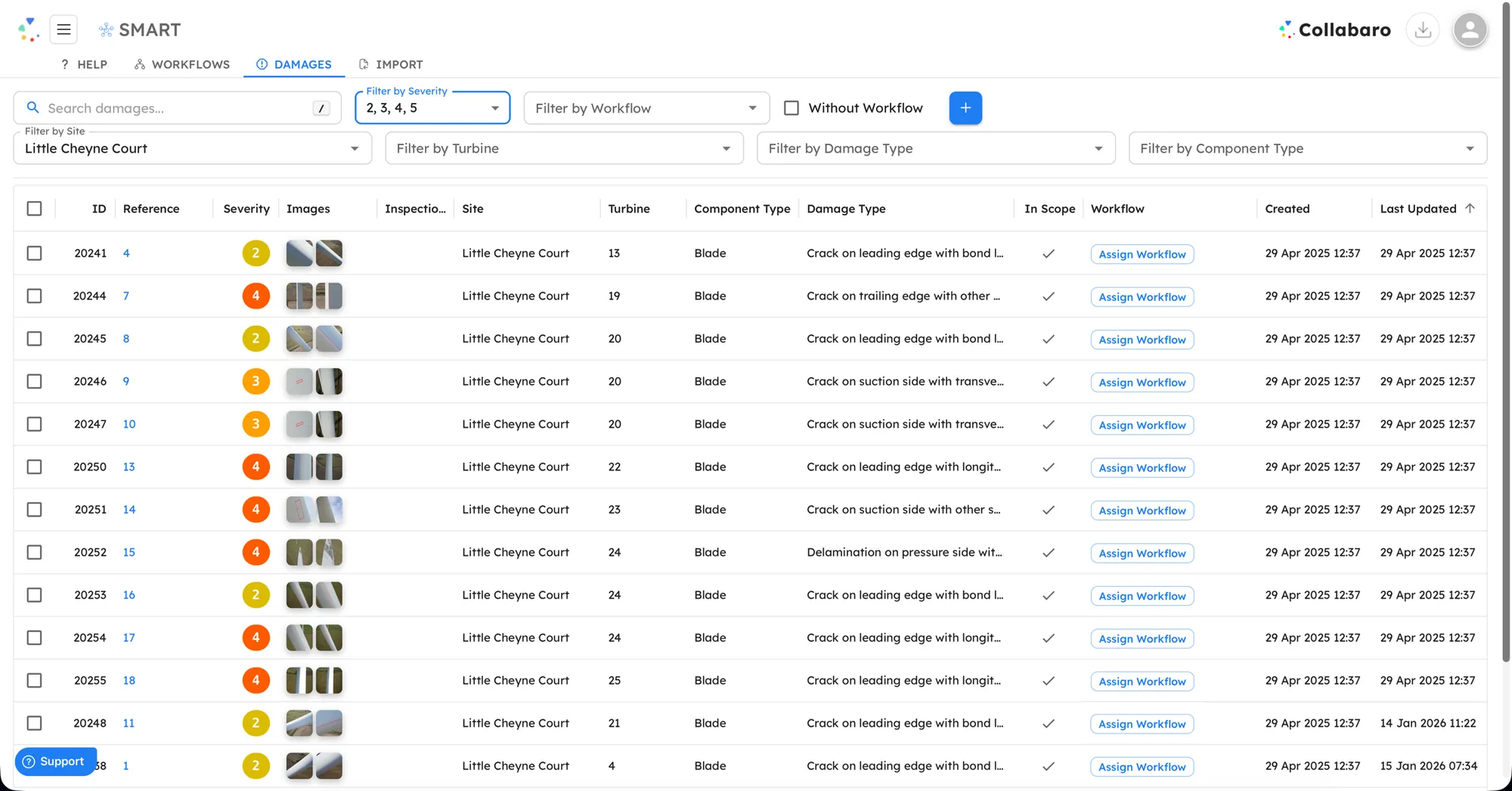
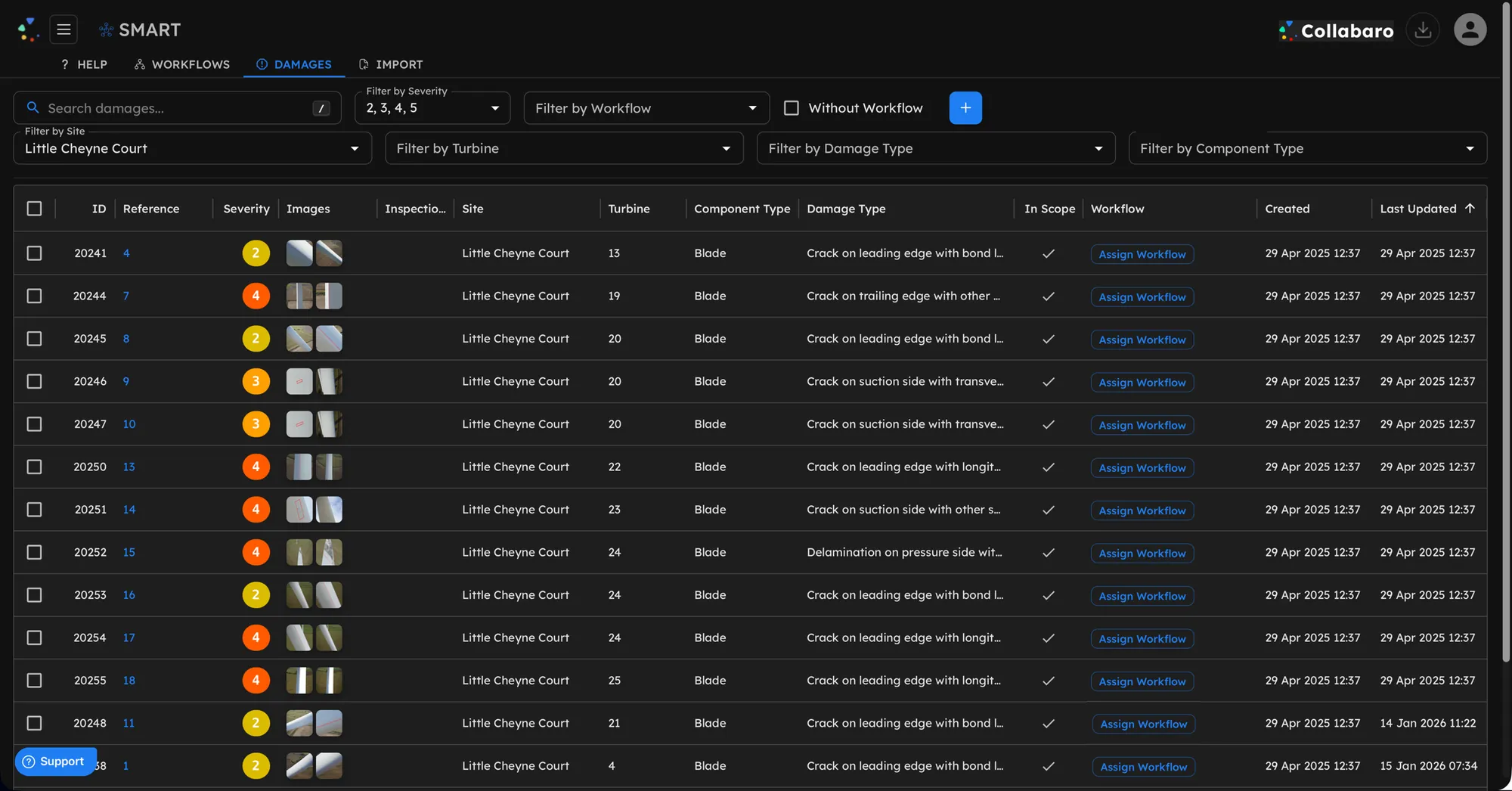
SCOPE™ is the part that tends to surprise people, because it works backwards. Point it at the inspection reports you have already commissioned and already paid for over the past several years, and it extracts every damage recorded in them into structured, comparable records. You are not commissioning fresh inspections to establish a baseline. You are recovering the baseline from documents that have been sitting on a shared drive the whole time.
BLADE™ handles the other direction. Technicians photograph the inspection board at height and the data comes off it into the same structure, with a confidence score against each extracted field so that nothing enters the record pretending to be more certain than it is.
SmartTask™ is the calibration step. Prescribed sequences mean two crews from two contractors record the same job the same way, because the workflow does not offer them a dozen different ways to describe the same damage.
What comes out of the other side is one record per damage, tied to a blade, carried from the original inspection through the tender, through the repair and through close-out. Sort it by severity, filter it by turbine, and look at what has moved in the last eighteen months. That is a dataset, and the dataset is the thing that has been missing.
The easiest megawatt
The argument for looking harder at assets you already own is a good one, and it reaches well beyond control strategy. The blades on your turbines are simultaneously a production variable you are not currently measuring and a lifetime variable you are managing largely by calendar. Neither of those is a technology problem. They are both a data problem, and the raw material for solving it is already sitting in reports you have paid for.
If you want to see what your own inspection history looks like once it has been structured, book a demo and we will run it against your reports rather than ours.
← Back to Field Notes