

Three contractors submit bids for the same repair campaign. Each one includes a damage summary built from the same set of OEM inspection reports. None of the three summaries agree.
That’s not because anyone is lying. It’s because three different people, at three different companies, spent three different weeks manually reading the same PDFs and typing what they saw into three different spreadsheets. One contractor’s technical lead rounds a borderline crack length up because their template only has whole-millimetre fields. Another logs it as a different damage category because their internal taxonomy splits things slightly differently. A third simply misses a page. An asset manager trying to compare the three bids apples-to-apples is, in practice, comparing three separate acts of manual transcription, not three readings of the same report.
There is supposed to be one truth in that inspection report. In practice there are as many versions of it as there are people who’ve retyped it.
Two teams, the same bottleneck
On the contractor side, a tendering team receiving 200 or 300 inspection reports has one option if they want to price the work: read every report and key the relevant fields into a spreadsheet by hand. It’s slow, it pulls senior people away from paying work, and it’s the kind of task where a decimal point gets mistyped at the end of a long day and nobody catches it until the tender is already submitted. On a time and materials contract, that kind of error is recoverable, the invoice reflects whatever the job actually turns out to need. A fixed-cost tender is less forgiving. Win the work at £2,000,000 and that can look like a healthy number the day the contract is signed. It can disappear quickly once you’re up the blade and the damage doesn’t quite match what was priced.
The person doing that extraction is usually the most expensive one available for the job, and they know they don’t have the week it would take to do it properly. So they triage. They read for the damages they expect to actually be pricing into the tender, typically Category 3 and 4, the ones sitting between “monitor” and “immediate action.” Category 1 and 2 findings, sometimes Category 5 items already flagged and dealt with elsewhere, get skimmed past. Not because they don’t matter, but because nobody is paying for the time to capture data that isn’t going into this particular quote.
The damages nobody priced into the tender don’t stop existing. They just stop being visible until someone finds them again by accident.
On the operator side, the problem shows up differently but comes from the same root cause. An asset manager reviewing bids, or checking a contractor’s completion report against the original inspection data, has no independent way to verify the numbers without redoing the same manual extraction themselves. In practice, most don’t. They take the contractor’s summary on trust, because checking it against 300 source PDFs isn’t a realistic use of anyone’s week.
Building the record
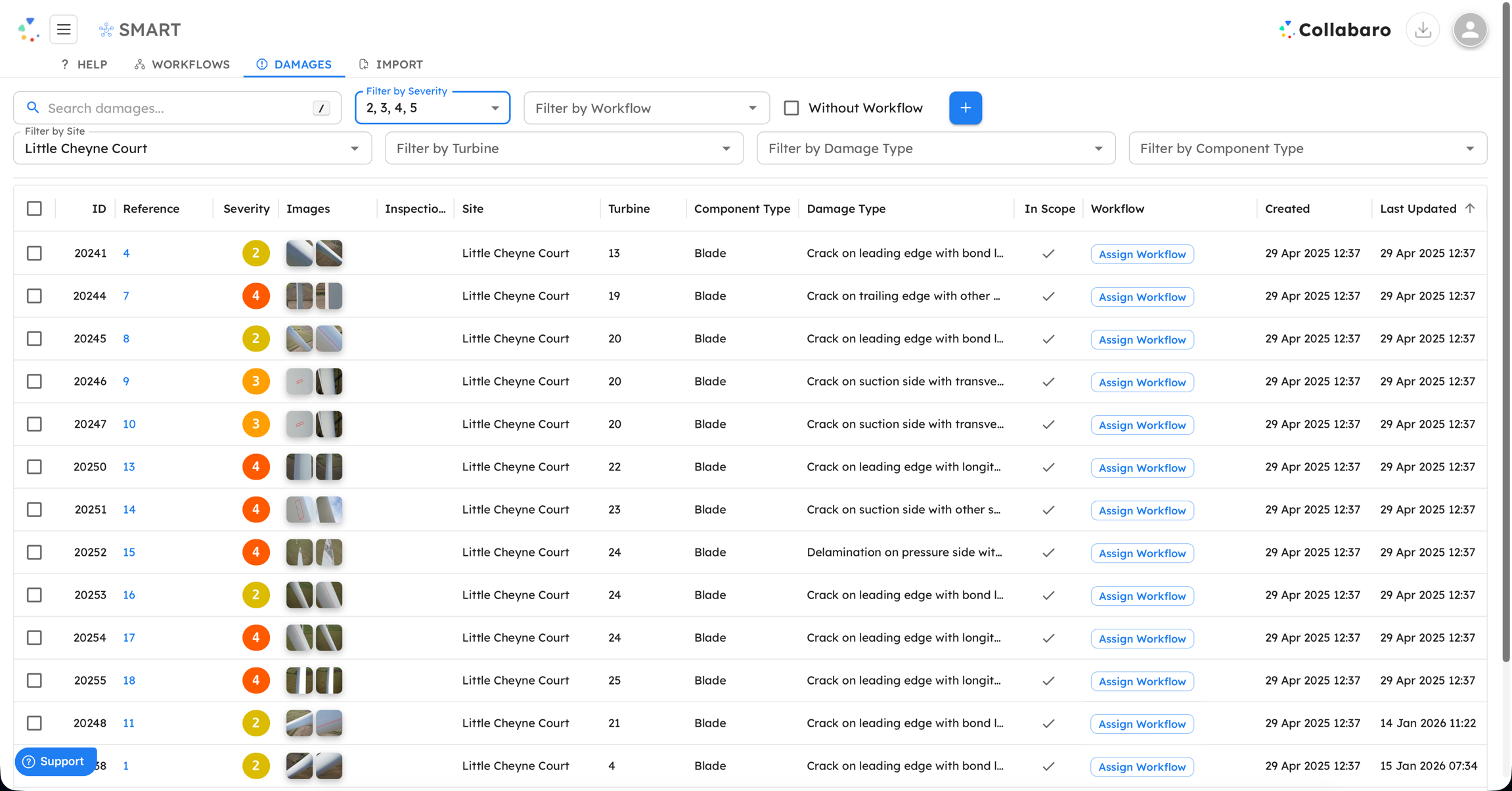
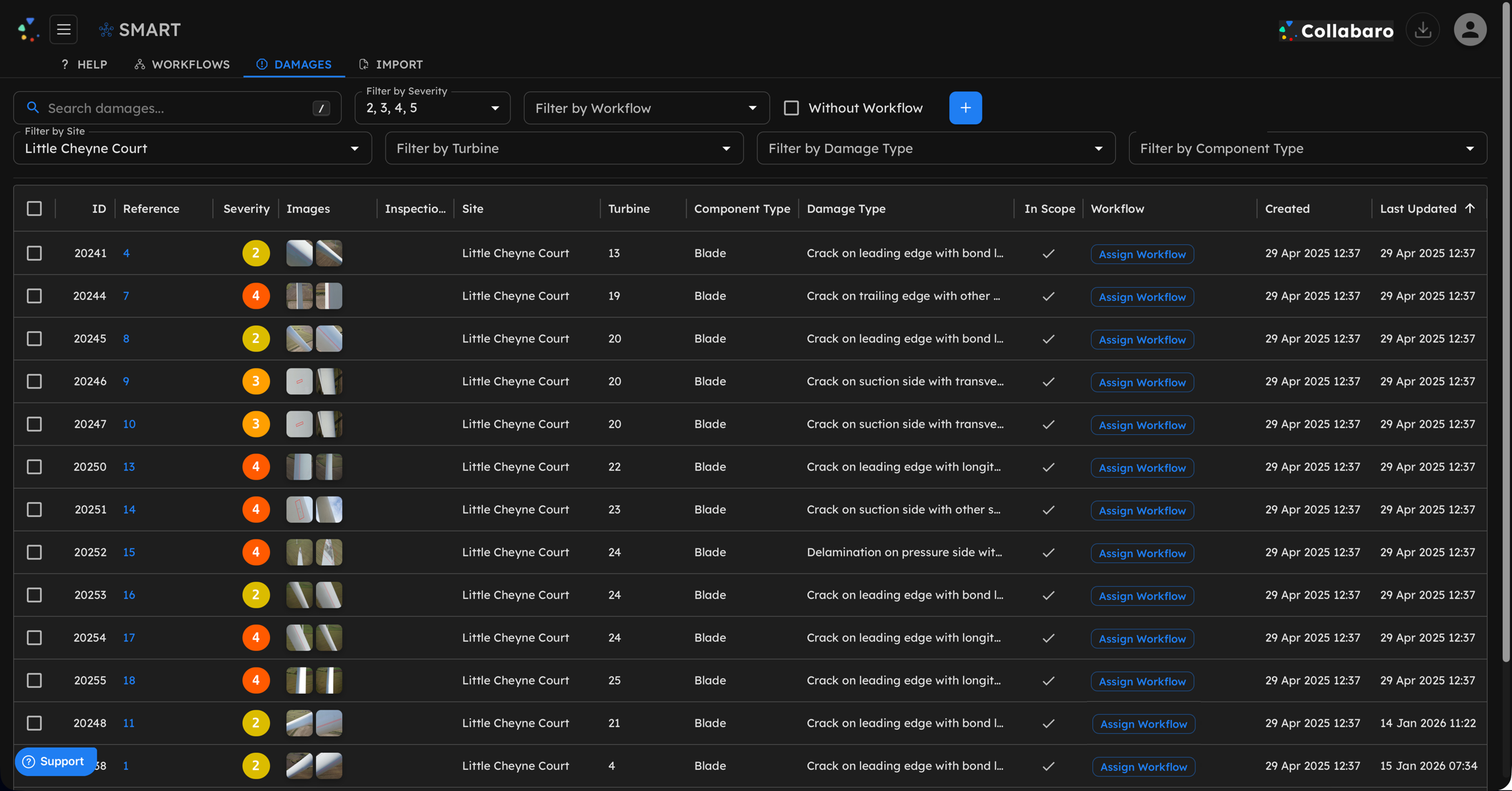
SCOPE™ processes inspection report PDFs in two passes. The first extracts the high-level metadata: site, turbine identification, report date, campaign context. You review and confirm that before anything deeper happens. The second pass goes through every individual damage instance in the report, all of them, not just the ones a time-pressed reviewer would have prioritised, pulling out the type, severity, location, and the original photograph attached to each one. Nothing is committed until a person has reviewed and confirmed it.
That’s the record of truth. Not a summary someone typed up under deadline pressure, but the full contents of the report, captured once and structured so it can be referred back to at any point, by anyone, without redoing the extraction.
Extracting data from a set of over 380 inspection reports by hand takes an experienced technical team about two working weeks. A contractor using Collabaro ran the same volume of reports through SCOPE™ and had it done in a few hours, a reduction in extraction time of more than 98%. Not 98% faster at doing the same job. The job itself, sitting and retyping report after report, largely stops being something a person needs to do at all. And because the PM wasn’t tied up for two weeks doing it, they stayed free to price other tenders in the meantime, rather than turning work away because there wasn’t capacity to process it in time.
From record to tender
Once the data is extracted, it can be filtered by whichever combination of parameters the tender actually needs:
- Site or wind farm
- Turbine ID and blade position
- Damage number or damage category
- Source inspection report
- Severity, location on the blade, and several other attributes
Filter, export to XLSX or CSV, and the result drops straight into the tender document. The only manual input left for the PM is the material estimate, where required, and the labour cost, figures we expect Collabaro to be able to estimate in the near future using the client’s own historical data. For an operator, the same extraction run independently against reports from multiple contractors becomes a single comparable dataset, built from the source documents rather than from each bidder’s own arithmetic.
From record to repair job
If the contractor wins the work, the record doesn’t get re-entered a second time. Select the damage, or a series of damages, assign the correct workflow or task type, and send it to an individual technician or a group. That’s the entire administrative step. One or two minutes, not the hours it used to take to stand up a new job from scratch, a reduction of more than 90% in the admin required to get an awarded repair into a technician’s hands.
The technician, or the team assigned to the job, sees the project and its jobs the moment their device syncs with the server. Where the workflow is set up to include it, that sync brings the original inspection report along too, and specific attributes from the original damage record, surface area being the obvious one, sit inside the workflow itself. The technician can stand at the blade and check what they’re looking at against what the report said, without digging through a separate document or waiting for someone back at the office to send it over.
A record of truth, until someone gets back on the blade
Here’s the part that’s easy to gloss over. As far as the OEM or the wind farm operator is concerned, the inspection report is the truth, right up until a technician is back on that blade doing the repair. Sometimes that’s a matter of weeks. Sometimes it’s several months. Blade damage doesn’t wait politely in the meantime. Erosion progresses. A crack that was 40mm at inspection can be longer by the time anyone is close enough to touch it again.
This is where most systems, paper or digital, quietly go wrong. The record gets treated as permanent, and whatever the technician finds on the day either gets forced to match it or gets recorded somewhere nobody downstream ever sees.
Collabaro pushes the original inspection report to the technician doing the repair, including the images and, where the original report captured it, the surface area of the damage. The technician arrives with the baseline in hand, not a verbal briefing or a half-remembered summary. If what they find has changed, a larger area, a different failure mode, damage that’s progressed beyond the original classification, they report the variation in real time to their PM. The PM can then inform the client, OEM or wind farm operator, before the repair proceeds rather than after an invoice raises the question.
The record of truth isn’t a single snapshot taken on inspection day and then left alone. It’s a running history of that specific damage, the original finding, any variation the technician reports back, who was told and when, so by the time the repair is closed out, the record tells the full story of that damage rather than just where it started.
Why this matters
For a contractor, that means responding to a tender in the time you actually have, bidding on more work in parallel, and turning awarded work into technician-ready jobs in minutes instead of days. For an operator, it means a bid built from the source documents rather than a contractor’s own arithmetic, and a repair record that shows not just what was inspected, but what was actually found when someone finally got back on the blade to fix it.
To see how the record gets built, from PDF to tender to technician, book a demo and we will walk it through against your own inspection reports.
← Back to Field Notes