

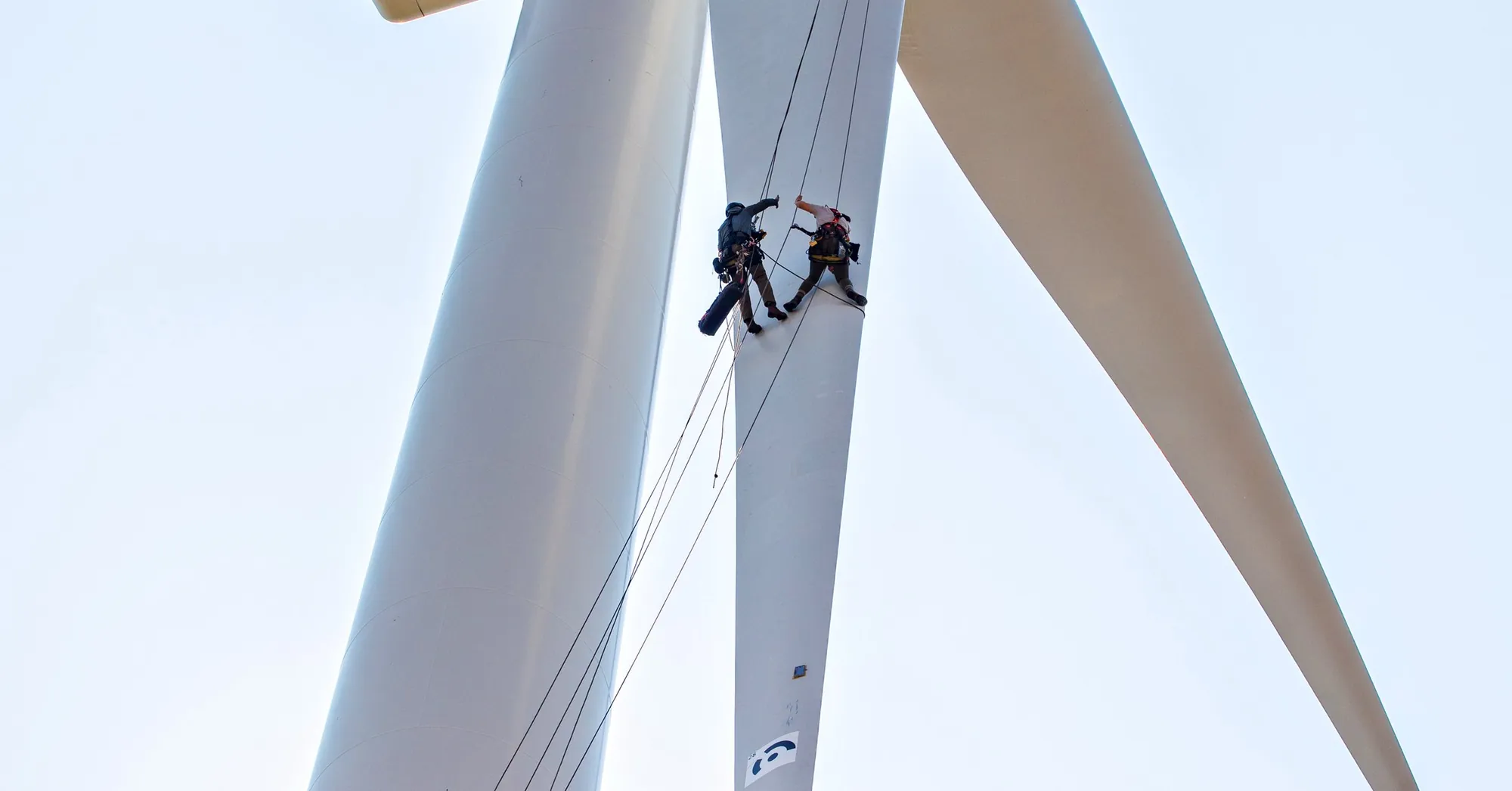
The pitch a decade ago was that drones would do away with rope access. It did not happen, and the reason is not complicated. A drone can find a crack in a few minutes from fifty metres away. It cannot grind that crack out, scarf it back, lay up new plies or put the coating on afterwards.
What drones did instead was more interesting, and it has been widely misread. They did not remove a job. They moved the bottleneck.
What drone inspection actually changed
It is worth being precise about the gain, because the marketing around it has not been.
Law and Koutsos, in a study of eighteen operational wind farms across the UK, put the position plainly: drone inspections were becoming common not because they were dramatically cheaper, but because at a broadly similar cost per turbine they were much quicker, and speed reduces the downtime the inspection itself causes.1
That is the real prize and it is a substantial one. The expensive part of a rope-access inspection was rarely the crew. It was the turbine standing still while they worked. Take the inspection window down from most of a day to under an hour and the saving lands on the generation side of the ledger rather than the maintenance budget.
So drones were a genuine advance, and anyone treating them as a fad has not been paying attention. The consequence, though, is not the one the industry expected.
Inspection stopped being the constraint
Once inspecting a turbine is quick and non-disruptive, you can do it far more often. And the more often you look, the more you find.
Leading edge erosion affects very nearly every turbine in operation, because the things that cause it are simply the weather.1 The scale of that is easy to underestimate. When EDP Renewables inspected 201 rotor blades on a single wind farm after fourteen years of operation, 174 of them, some 87 per cent, showed visible erosion, and half the blades on the site were severely eroded.1
The same study measured what that costs. Across the operational turbines examined, medium levels of erosion were associated with an average annual energy production loss of 1.8 per cent, and the worst affected turbine was down 4.9 per cent.1 Those are not rounding errors on a twenty-year asset.
Put those two things together and the position becomes clear. Better inspection did not reveal a clean fleet that occasionally needs attention. It revealed a backlog. Operators who improve their inspection regime tend to find more work rather than less, and to find it faster than they can schedule crews to deal with it.
Inspection is no longer the constraint. Repair capacity is.
The handover nobody owns
Here is where the money now leaks, and it is nobody’s fault in particular, which is precisely the problem.
The drone operator’s obligation ends when the report is delivered. The rope access contractor’s obligation begins when the work order arrives. Between those two points sits a PDF, a spreadsheet somebody built by hand, a prioritisation argument, and a procurement process. Nobody is contracted to own that gap, so it absorbs weeks.
Turning “category 3 damage at 43 metres on the leading edge of blade B” into a technician on a rope with the right resin, the right method statement and the right access plan is real work. At the moment it is mostly done by somebody re-keying findings out of one document into another, which is slow, and which introduces errors into the one record that ought to be reliable.
The authors of that erosion study reach for the same idea from the research side, arguing for correlating the extent of erosion with the resulting energy loss specifically in order to optimise repair logistics.1 That is the right instinct. The obstacle is not analytical sophistication. It is that the damage data and the repair scheduling live in different systems, in different companies, in different file formats.
The scarce resource is not the drone
This is the part that changes how you should think about the problem.
Drone capacity is easy to add. You can buy another aircraft, or another survey, more or less on demand. Rope access capacity is not like that. It takes years to produce a technician who can be trusted on a structural repair unsupervised, and the industry is not producing them fast enough. The Global Wind Organisation and GWEC put the sector’s requirement at 628,000 people by 2030, and list improving retention alongside training capacity as a precondition for getting anywhere near that figure.2
If skilled rope hours are the genuinely scarce input, then every one of those hours matters in a way drone hours do not. An afternoon spent on a turbine that could have waited another season, or a morning lost because the technician arrived without the original inspection imagery and had to re-establish what they were looking at, is not an administrative annoyance. It is the constrained resource being spent badly.
We have written separately about why this industry struggles to hold on to the technicians it trains. The two problems are the same problem viewed from different ends.
What good looks like
The fix is not more inspection technology. It is closing the gap between the finding and the repair so the scarce hours land where they are worth most.
Closing that gap is what Collabaro is built to do, so I will declare the interest and then be specific about what it actually involves.
Two ways in, and most operators need both
Where the inspection is already digital, damage records come in from the drone platform through the API without anyone re-keying anything. We do this today with Perceptual Robotics, and any inspection platform with an API works the same way, though the integration itself takes some setting up depending on the platform.
Where the inspection was done by rope or from the ground, or where it was done by a drone whose output you receive as a document rather than a feed, the finding arrives as a PDF. That is still the common case, and it is the case that matters most, because it also covers every report already sitting in the archive. SCOPE™ extracts the damage data straight out of those reports into the same structured records, rather than only the ones a rushed tender would have had time to pick out.
Extraction runs in two passes. The first pulls the metadata, the site, the turbines, the dates and the campaign context. The second goes after every individual damage recorded in the report, including the original damage photographs. A person reviews and confirms both before anything is committed, which matters, because the reasonable first reaction to automated extraction is to ask how you would know it was right.
What that is worth in time
These are our own production figures rather than anything from the literature, so take them as such.
We recently ran 350 OEM inspection reports for a contractor preparing a large tender. Done by hand, that is two people for a week. Through SCOPE™ it came to a few hours of extraction and a few hours of technical review. On a smaller job, 40 OEM inspection reports went to structured tower damage data exported as CSV in twenty minutes, against a day or two of manual work.
It is worth being clear about whose time that is. The person who would otherwise be keying damage records out of 350 PDFs is not junior. It is the project manager or the senior technical lead, because they are the only ones who can tell a structural finding from a cosmetic one. So the handover does not merely delay the technician on the rope. It takes the most experienced people in the business and puts them on data entry for a week, and it does it at exactly the point in a tender when their judgement is most needed elsewhere. It is the same problem as the technician losing an evening to reporting after a twelve-hour shift, simply further up the organisation.
Deciding, and then acting on the decision
Once the data is structured it can be sorted the way the decision actually needs to be made, by severity, by turbine, by how long the damage has been open, and increasingly by what it is costing in lost production rather than what it costs to fix. A category 3 on a turbine losing four per cent of its output is not the same commercial proposition as the same category 3 somewhere sheltered, and treating them identically is how repair budgets get spent in the wrong order.
The part that tends to get overlooked is what happens after that decision. Having chosen which damages are to be repaired, those damages become Projects and Jobs in Collabaro in minutes rather than being retyped into a scheduling system by somebody working from the spreadsheet again. Each one carries its own damage detail, the original inspection photographs and, where it is wanted, the source report.
All of that reaches the technician on their phone through Collabaro Field. No re-keying, no emailed PDFs, no briefing meeting to explain what the report already said. They arrive on the rope knowing what they are looking at, which means the first hour of a scarce, expensive day is spent repairing rather than orienting.
None of that reduces the number of repairs the fleet needs. It changes how many of the available technician hours go into performing them, and how much of your senior people’s week goes into deciding which ones.
Not fewer people. Better-aimed people.
The framing that drones and rope access are in competition was always a category error, and it has quietly cost the industry a few years of attention pointed at the wrong problem.
Inspection is solved, or close enough to solved that it is no longer what limits you. Repair capacity is limited, expensive and slow to grow. Everything between the two is largely manual and owned by nobody. That middle section is the only part of this that is cheap to fix, and it is the part almost nobody has looked at.
If you want to see what your own inspection data looks like once it has been structured and prioritised against a repair schedule, book a demo and we will run it against your reports.
References
- Law, H. and Koutsos, V. ‘Leading edge erosion of wind turbines: Effect of solid airborne particles and rain on operational wind farms.’ Wind Energy, 2020. Open access under CC BY. doi.org/10.1002/we.2540
- Global Wind Organisation and Global Wind Energy Council. Global Wind Workforce Outlook 2025–2030. Published 4 December 2025. globalwindsafety.org