

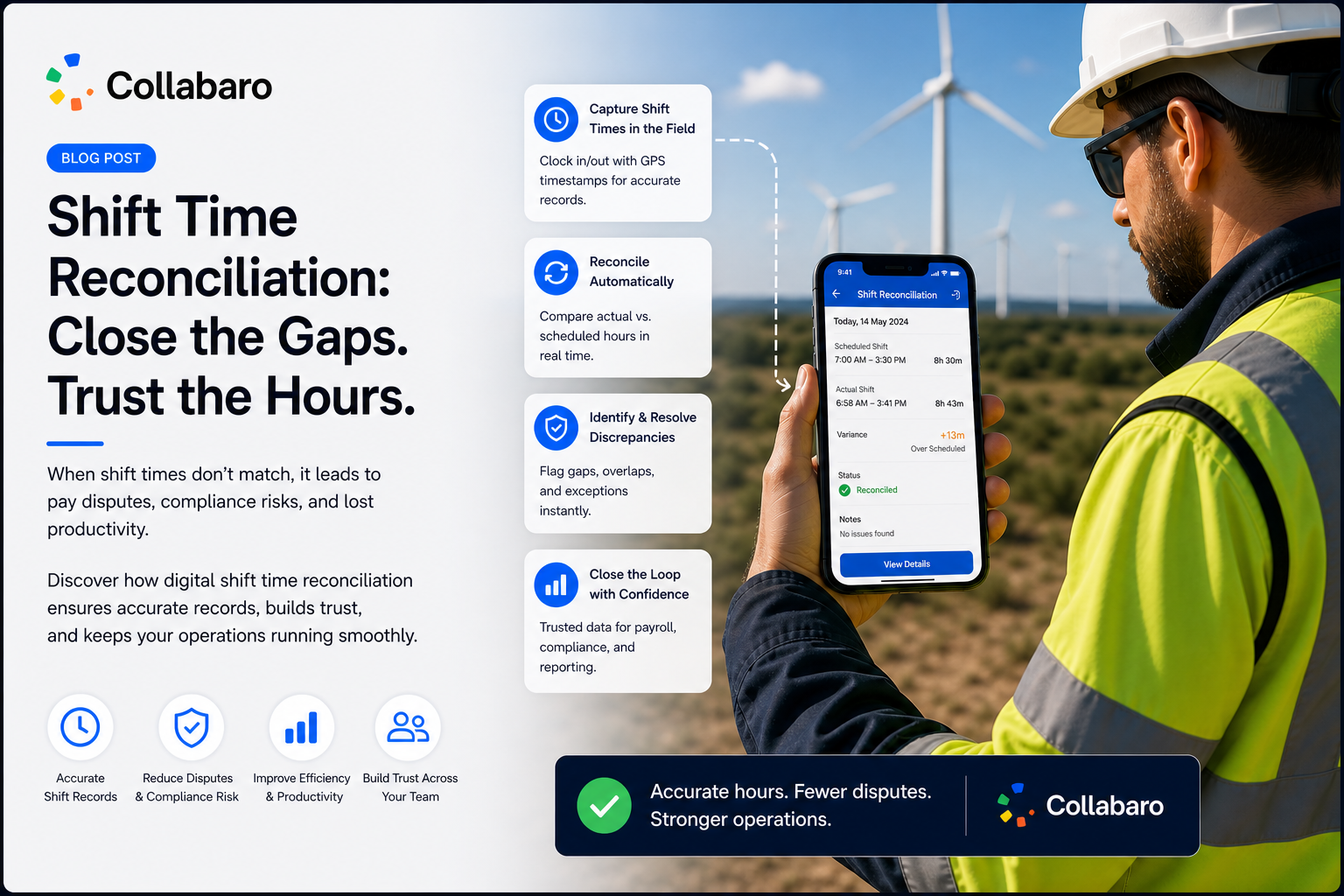
At the end of every shift on a wind energy campaign, someone needs to account for the hours. How many technicians were on site. How long each one worked. How much of that time was productive work versus standby, weather downtime, or travel. These numbers flow directly into the invoice the contractor sends to the OEM, and they are one of the most frequently disputed line items in the entire commercial relationship.
The dispute rate on timesheet data in blade service contracts is disproportionately high relative to the value at stake. A fifteen-minute discrepancy on one technician's shift is commercially insignificant on its own. But when that discrepancy is multiplied across a team of six, over a four-week campaign, and the OEM's commercial team has no way to verify the numbers without going back to the contractor, the cumulative effect is significant. It creates friction, delays payment, and consumes management time on both sides.
Where Shift Time Disputes Come From
Most timesheet disputes do not stem from dishonesty. They stem from ambiguity. The raw facts of a shift are rarely in question: everyone agrees the team was on site. The disputes arise in the categorisation and boundaries of time.
The Standby Problem
Wind energy campaigns are uniquely susceptible to weather-related downtime. A team of rope access technicians cannot work if wind speeds exceed the safe limit for their discipline. They may arrive on site at 06:00, wait for two hours for the wind to drop, work a four-hour window, and then stand down again at midday when conditions deteriorate. The total shift is eight hours. The productive work time is four. The remaining four hours are standby.
Different contracts treat standby differently. Some pay standby at a reduced rate. Some pay it at full rate. Some distinguish between "on-site standby" (waiting at the turbine) and "off-site standby" (at the hotel). Without a clear, contemporaneous record of when standby started and ended, and why, the OEM has no way to verify what is being claimed. This is where disputes originate: not in the existence of standby, but in its duration and classification.
Travel Time Boundaries
Travel time is another common friction point. Most contracts allow billable travel time from the accommodation to the wind farm. But what counts? Door to door? Gate to gate? Does a fuel stop count as travel or as a break? If the team is redirected mid-journey to a different turbine cluster, does the additional driving time count as travel or as mobilisation? These edge cases are rarely defined clearly enough in the contract to prevent dispute, and they recur on every campaign.
Shift Start and End Times
On a typical campaign, the team lead records the shift start and end times for their crew. This might be done on a paper form, a WhatsApp message, or a note on a phone. The project manager in the office then enters these times into the timesheet system. If the team lead wrote "started 06:15" and the project manager enters "06:00" (rounding to the nearest quarter hour, as is common), that fifteen-minute difference is now embedded in the record. Multiply by six technicians and twenty working days, and the cumulative rounding becomes commercially material.
The dispute is never about whether someone was on site. It is about what category of time their presence falls into, and who gets to decide.
The Cost of Getting It Wrong
Payment Delays
When an OEM queries a timesheet submission, the invoice is paused. The contractor's commercial team must pull the original records, cross-reference them with the daily reports, and respond to the query. The OEM reviews the response. This cycle takes a minimum of one to two weeks and can stretch to a month on complex campaigns. For a contractor carrying the operational costs of a completed campaign (technician wages, accommodation, equipment hire), a four-week payment delay is not a minor inconvenience. It is a direct hit to cashflow.
Margin Erosion
Inaccurate time recording cuts both ways. Underreporting productive hours means the contractor bills less than they are entitled to. Overreporting creates disputes that consume management time to resolve, and if the OEM applies a blanket correction, the contractor may end up conceding hours that were legitimately worked. In either case, the contractor's margin on the campaign is eroded by data quality, not by operational performance.
Relationship Damage
Repeated timesheet disputes create a trust deficit that extends beyond the individual campaign. An OEM that has to query every invoice develops a perception that the contractor's data is unreliable. This perception influences future procurement decisions. It does not matter whether the discrepancies were genuine errors or rounding artefacts. The commercial relationship is damaged by the perception of inaccuracy.
What Good Reconciliation Looks Like
The solution is not more detailed timesheets. It is reconciliation at the point of work, before the data leaves site.
Team Lead Review on Mobile
At the end of each shift, the team lead reviews and approves the time entries for their crew on a mobile device. They can see each technician's logged hours, the breakdown between productive time and standby, and any notes or flags. They confirm or adjust before leaving site, while the context is fresh. This is not a new administrative burden. It replaces the existing process of the team lead sending a WhatsApp summary to the project manager, except the data is structured, timestamped, and digitally signed.
Category Enforcement
Time entries are captured against predefined categories that match the contract terms: productive work, weather standby, on-site standby, travel, non-productive time. The system does not allow a generic "hours" entry. Every minute is categorised at the point of capture, by the person who was there. This eliminates the post-hoc categorisation that creates most disputes.
Daily Reconciliation, Not End-of-Campaign
When time is reconciled daily, discrepancies are caught within hours, not weeks. If a technician's logged hours do not match the shift schedule, the team lead sees it that evening. If standby time is logged on a day when the weather data shows conditions were within working limits, the flag appears immediately. By the time the campaign ends, the timesheet data has already been reviewed and approved 20 or 30 times, once per shift. The end-of-campaign reconciliation is a formality, not a project.
The Downstream Effect
When shift time is reconciled daily and approved at source, every downstream process accelerates. The project manager does not need to spend days rebuilding timesheets from fragments. The commercial team does not need to defend numbers they cannot verify. The OEM receives timesheet data that has already been reviewed by the person who was on site, with a digital audit trail.
Invoicing moves from weeks after demobilisation to days. Query rates drop. Payment cycles shorten. And the contractor's reputation for data accuracy becomes a competitive advantage rather than a commercial liability.
This is the approach SmartTask™ takes to shift time reconciliation: team leads review and approve on mobile before leaving site, with structured categories that match the contract terms and a daily reconciliation rhythm that catches discrepancies while they can still be resolved from memory, not spreadsheets. If timesheet disputes are costing your team time and margin, we are at WindEurope 2026 in Madrid this week (21–23 April, Stand 9-D46). Come and see us for a live demo. Not at the event? Book a demo and we will set up a call.
← Back to Field Notes