

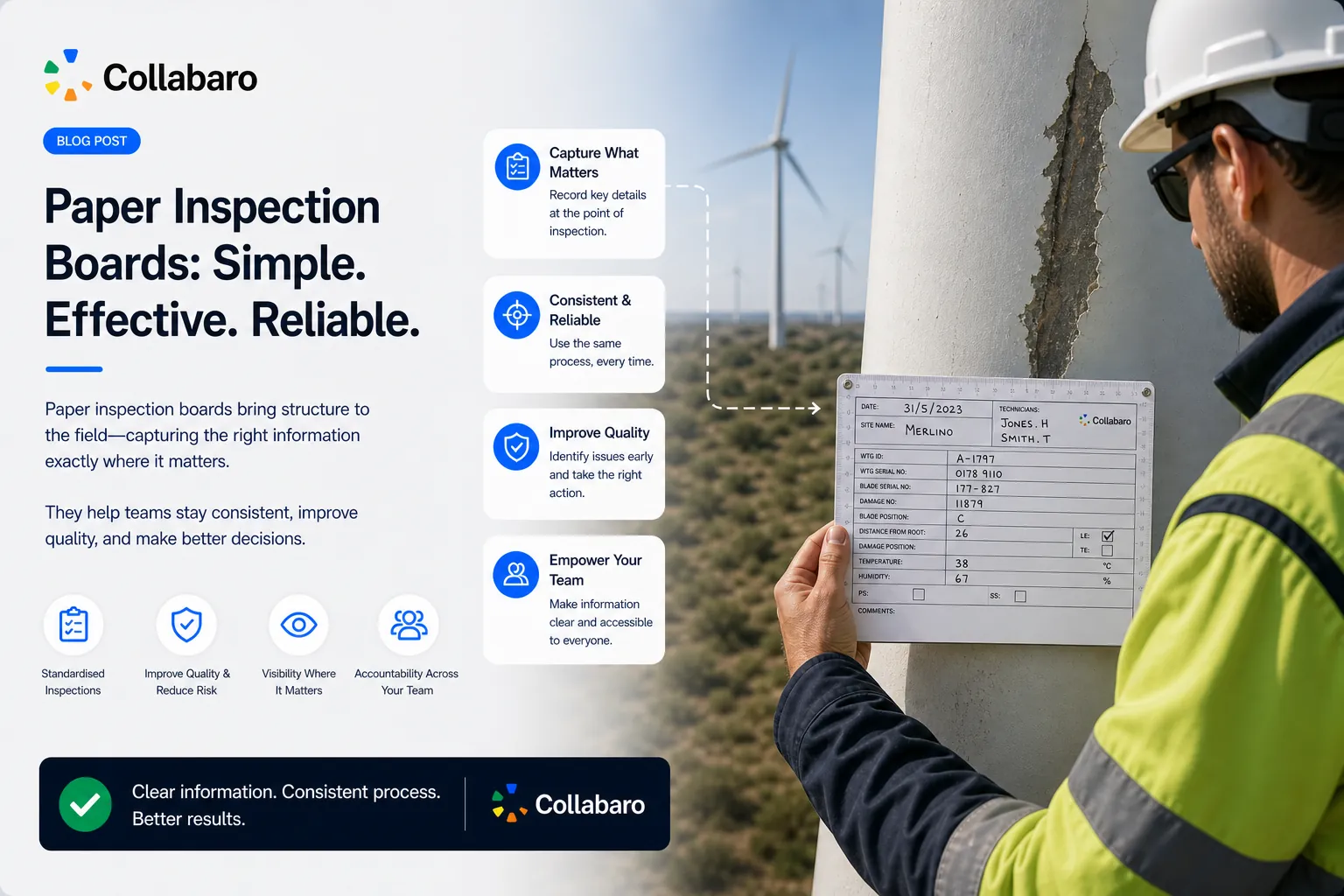
Walk onto almost any blade inspection campaign today and the recording process at height looks much the same as it did ten years ago. A technician on the rope fills in an inspection board with the site, turbine ID, blade serial, position, section, damage number and type, severity, temperature, humidity, and the names of the technicians doing the work. The board goes in front of the damage. The photograph is taken. The board is wiped and rewritten as the technician moves from finding to finding. Over a full shift that cycle can run twenty to fifty times.
Later, those photographs get transferred. Best case, it happens automatically. Worst case, they are shared by USB, AirDrop, WhatsApp, shared phone albums, or whatever else works in the moment. The images arrive. The project record often does not.
Sometimes a project manager or administrator transcribes the board contents into a database or spreadsheet. Often, the information stays inside the photograph: visible, but not structured, not searchable, and not something you want to dig through when a warranty claim or compliance audit lands months later. By the time it reaches a PDF client report, it is no longer really data. It is a picture of data.
This is sometimes called point-of-capture data quality: the principle that data errors and losses happen in the field, not the office, and that fixing them downstream costs far more than preventing them at source.
Inspection boards have lasted this long for good reason. They are simple, durable, and well suited to the conditions at height. No power, no login, no removing gloves at 80 metres to navigate a menu in the wind. Any replacement that ignores those constraints will fail quickly. The real cost is not in the board itself. It is in what happens to the data after the photograph is taken.
The Measurable Costs of Unstructured Data
Transcription Time
The most visible cost is the time spent manually keying inspection data from photographs into a digital system. Take a representative campaign of 45 turbines, three blades per turbine, and an average of 10 findings per blade. That is 1,350 individual records. At two to three minutes per record to read the board, interpret handwriting, enter the data, and link the image, transcription alone consumes roughly 45 to 70 hours of office time. That is more than a full working week spent retyping information that was already written down once in the field.
Transcription Errors
Manual transcription creates risk even when the process feels routine. Beamex benchmarks manual data entry at around 1% error per data point. On a campaign with 1,350 findings and ten-plus fields per finding, the data passes through two manual stages: handwriting at height, then keyboard entry in the office. By Beamex's calculation, that compounds into roughly 40% of records containing at least one error, because the probability adds up across every field in every record.
The conditions make it worse. Handwriting done at 80 metres in wind and cold is harder to read than handwriting done at a desk. The transcriber is working from a photograph of a board, not the board itself. A 5 can be misread as an S, B2 as B3, severity 2 as 3. These errors rarely get caught immediately. They surface later, when someone cross-references the data for a warranty claim, an OEM query, or a compliance audit.
Lost or Illegible Data
Whiteboards get smudged. Marker pens fade in rain. Photographs are taken at angles where the board is partially obscured or out of focus. In every campaign we have encountered, there is a subset of findings where the board data cannot be read with full confidence. Those records are either entered with a best guess or left incomplete.
Delayed Data Availability
With a manual inspection board workflow, inspection data is rarely available in a usable form straight away. The OEM cannot review findings as structured records at the moment they are captured. The project manager often cannot assess progress until photographs have been uploaded and, in some workflows, transcribed. A critical finding photographed at 10am may not reach the decision-makers who need to review it until the following day, or later.
The inspection board is not the problem. It is a symptom of the problem: the absence of a digital capture layer at the point of work.
A better approach does not ask technicians to abandon the board. It turns the board photograph into structured data as part of the workflow they already follow.
What Stops Digital Tools from Working at Height
The barriers are not technical in the way most people assume. They are environmental, human, and organisational, and any solution that does not account for all three will not last beyond the first campaign.
Connectivity
Many wind farm sites, particularly offshore, have limited or no cellular coverage. A digital tool that requires an internet connection to function is useless to a technician offshore or on a remote site. Any serious solution has to work fully offline.
Simplicity and Adoption
Technicians work in physically demanding, safety-critical environments. Scrolling through menus, typing on a touchscreen with gloves, or navigating a complex interface while suspended on a rope is not a minor inconvenience. It is a real barrier. Tools that require manual keyboard input at height will see low adoption because the design does not match the environment.
Adoption also has a human layer. Experienced technicians are skilled professionals, and digital tools that introduce location tracking, time-stamped records, or task-completion monitoring can be perceived as surveillance rather than support. Whether or not that is the intent, the effect is the same: low engagement, workarounds, and incomplete data.
Both problems point to the same conclusion: ask the technician to do less, not more. If the photograph is already being taken, the most effective workflow treats it as the primary input and asks only for a confirmation. A tap on a high-confidence extraction, a quick correction on a low-confidence one. No new behaviour at height.
Change Management
Blade service companies are operationally conservative, and for good reason. A process that works reliably, even if it is inefficient, often feels less risky than a new process that might fail in the field. The switching cost is not just financial. It is organisational: retraining technicians, updating procedures, and adapting to new workflows mid-campaign.
Why Drone Inspections Do Not Solve the Data Problem
Drone-based external inspections are now an important part of blade condition assessment. For broad screening across large fleets, they can offer clear advantages in speed, cost, and safety over sending rope-access technicians to every blade for a first-pass inspection.
But drone survey data and repair-ready data are not the same thing. A drone can identify visible defects. It does not always define repair scope on its own. Depth profile, internal condition, material state, and final repair method often still require follow-up assessment by an experienced rope-access technician using additional tools.
The bigger issue is what happens to the data next. If inspection findings end up in PDFs, email chains, or disconnected image folders, they remain difficult to search, query, trend, audit, or defend later. That problem exists whether the original inspection came from rope access or from a drone.
Collabaro ingests inspection data from any source, including drone survey outputs. Once a client decides which damages to repair, that decision can become the starting point for structured projects, jobs, tasks, and material requirements. Identifying defects is one part of the work. Turning findings into usable operational data is the other.
How AI Extraction Turns Board Photos into Structured Data
What actually replaces a manual inspection board? Not a generic data collection app. Something purpose-built for the workflow of blade inspection at height, and simple enough to fit around the job rather than add to it.
The technician photographs the inspection board as they already do. The system uses AI to extract the board contents automatically. Turbine ID, blade position, section, damage type, and severity are read from the image and populated into structured fields with a confidence score.
The technician reviews and confirms. High-confidence extractions are accepted with a tap. Lower-confidence ones are corrected quickly. The time per finding drops from minutes of office transcription to seconds of field confirmation. The record becomes available immediately, even offline. When connectivity returns, it syncs to the project dashboard and, where configured, to OEM or client systems via API. The photograph is linked automatically to the correct turbine, blade, section, and finding. No manual sorting. No orphaned images.
That is BLADE™, which stands for Board Logging and Automated Data Extraction. Technicians keep using the board they already know. The photograph they already take becomes the data entry. The transcription step disappears.
It is worth stating plainly that AI is not a magic bullet. It is improving quickly, and extraction accuracy gets better month by month, but it can still make mistakes. In practice, when technicians write the inspection board clearly in block capitals with legible spacing and consistent field completion, extraction accuracy is close to 100%. The single most effective thing a team can do to improve data quality downstream costs nothing and takes no extra time. It is simply writing clearly. That is why technician confirmation remains part of the workflow. The objective is not blind automation but fast, reliable structured capture with the technician still in control.
BLADE™ working alongside Task Designer also supports material traceability. Batch numbers and expiry dates from primers, fillers, and coating materials can be photographed as part of standard laminating, painting, and filling workflows, then read and stored as structured records in Collabaro. For anyone who has had to defend a warranty claim by proving the right materials were used within their valid period, having that data already structured and searchable rather than buried in a folder of site photographs matters a great deal.
The Business Case for Structured Inspection Data
For a contractor running 15 campaigns a year, the representative model above suggests that eliminating manual transcription could recover something in the region of 675 to 1,050 hours of office time annually. That is a substantial amount of administrative effort removed from the process.
But the bigger value is often not labour time. It is evidence.
For teams that simply embed inspection board photos in a PDF report and stop there, the cost may not be obvious during the campaign. The process feels efficient enough. The client receives the report. The job closes. The cost appears later, usually as a warranty claim, an OEM query, or a compliance audit.
When that request lands and the evidence lives in a folder of JPEGs, every answer has to be reconstructed manually from photographs, labels, and boards frame by frame. That can take days. Sometimes it is incomplete. Sometimes it is not realistically recoverable at all.
Structured data changes that completely. When batch numbers, expiry dates, curing temperatures, and material references are captured as structured fields at the point of work, demonstrating compliance takes minutes rather than days. The record already exists. It is already linked to the correct turbine, blade, finding, and date.
The real cost of unstructured inspection data is not always the admin time. Sometimes it is the warranty claim you cannot defend, the audit you cannot answer cleanly, or the OEM relationship weakened because you could not produce the evidence that the work was done correctly, even when it was.
The inspection board is not going away, nor should it. It is a practical tool for a difficult environment. What needs to change is the assumption that the data on it has to remain locked inside a photograph.
If that problem sounds familiar, book a demo and we will show how inspection board photos become structured records in seconds, and why that matters when the next warranty question or compliance audit arrives.
Frequently Asked Questions
What is an inspection board in wind turbine blade maintenance?
An inspection board is a laminated card or small whiteboard used by rope-access technicians during blade inspections. The technician writes key data fields onto the board with a marker pen, holds it next to the damage, and photographs both together. The fields typically include turbine ID, blade serial number, blade position, section, damage type, severity, temperature, humidity, and technician names. The board is then wiped and rewritten for the next finding. It is a simple, durable tool well suited to working conditions at height, and it remains standard practice on most blade inspection campaigns today.
Why is blade inspection data often unstructured or hard to use after a campaign?
Because the data is typically captured as a photograph of a handwritten board rather than as a structured digital record. In most campaigns, that photograph ends up embedded in a PDF client report and is never transcribed into a searchable database. The information is visible but not queryable. It cannot be filtered, trended, audited, or retrieved quickly when a warranty claim or compliance question arrives months later.
What does BLADE™ stand for?
BLADE™ stands for Board Logging and Automated Data Extraction. It is an AI-powered feature within Collabaro that reads the contents of an inspection board photograph and extracts the data into structured fields automatically, with a confidence score for each field. The technician confirms or corrects the extraction at the point of work. The result is a structured inspection record created from the photograph the technician was already taking, with no additional data entry required.
Can drone inspection data be used to manage a blade repair campaign?
Drone surveys are effective for identifying and classifying surface defects across large fleets. But drone output, typically a condition report with annotated images, does not automatically translate into a structured repair campaign. Blade serial numbers and WTG-IDs are often absent or inconsistent in drone datasets, and depth profiles and internal condition data still require rope-access follow-up. Collabaro can ingest drone survey outputs and, once a client has identified which damages to repair, convert those decisions into structured projects, jobs, tasks, and material requirements.
How do blade service contractors demonstrate compliance with work instructions or warranty requirements?
When data is captured as structured records at the point of work, including batch numbers, expiry dates, curing temperatures, and material references, compliance questions can be answered in minutes by querying the inspection database. When data exists only as photographs embedded in PDF reports, answering the same questions requires manually searching through potentially thousands of images. That can take days and may not produce a complete or defensible record.
Why do wind turbine technicians resist using digital inspection tools on site?
For two main reasons. The first is practical. Typing on a digital keyboard at 80 metres in wind and cold, with gloves on, is genuinely difficult, and tools that require it will see low adoption regardless of their other merits. The second is cultural. Digital tools that introduce location tracking, time-stamped task logs, or completion monitoring can be perceived as surveillance by experienced field professionals. Both barriers are reduced significantly when the tool asks the technician to do less rather than more, specifically when it uses AI to extract data from a photograph the technician was already taking, and asks only for a confirmation tap rather than manual data entry.
← Back to Field Notes